Integration vs. The High: Are You Healing or Just Chasing the Experience?
This is for anyone who has ever emerged from a powerful healing session feeling like they’ve touched the stars, only to find themselves back in the same reactive patterns, the same heavy exhaustion, and the same biting self-doubt forty-eight hours later.
It’s for the seekers who move from workshop to workshop, ceremony to ceremony, and session to session, yearning for that lightning-bolt moment of clarity: the "big release": while their daily lives remain largely unchanged.
In the world of deep personal transformation and 9D Breathwork, there is a vital distinction we must make if we are to truly reclaim our sovereignty: the difference between chasing the high and integrating the work. One is a temporary state change; the other is a permanent cellular evolution.
The Seduction of "The High"
We live in a culture of "more." More intensity, more drama, more peak experiences. In the realm of wellness, this often manifests as a desire for the most cathartic, explosive sessions. We want to scream, we want to see visions, we want to feel the "9DMT trip" of our own biology.
There is nothing inherently wrong with these experiences. In fact, they can be a powerful doorway to the subconscious mind. However, when we prioritize the experience over the evolution, we risk falling into what psychologists call spiritual bypassing.
Spiritual bypassing is the use of spiritual practices: like breathwork or meditation: to avoid unresolved psychological wounds, emotional pain, or the "boring" work of daily life. It’s a way of using the breath to escape the body rather than inhabit it. When we chase the high, we are often looking for a bypass around the discomfort of our reality. We aren't healing; we are just changing the channel for an hour.
What is Integration, Truly?
If the session is the "opening," integration is the "weaving."
Integration is the process of taking the insights, the somatic releases, and the nervous system shifts experienced during a 9D Breathwork session and grounding them into your waking reality. It is where neuroplasticity: the brain's ability to reorganize itself by forming new neural connections: actually happens.
Research suggests that while intense breathing techniques can trigger significant state changes, the long-term benefits for stress, anxiety, and PTSD are most profound when the practice is paired with somatic regulation and cognitive meaning-making [1][6]. Integration is the bridge between the "breathwork high" and the "authentic self."

The Science of the "Messy Middle"
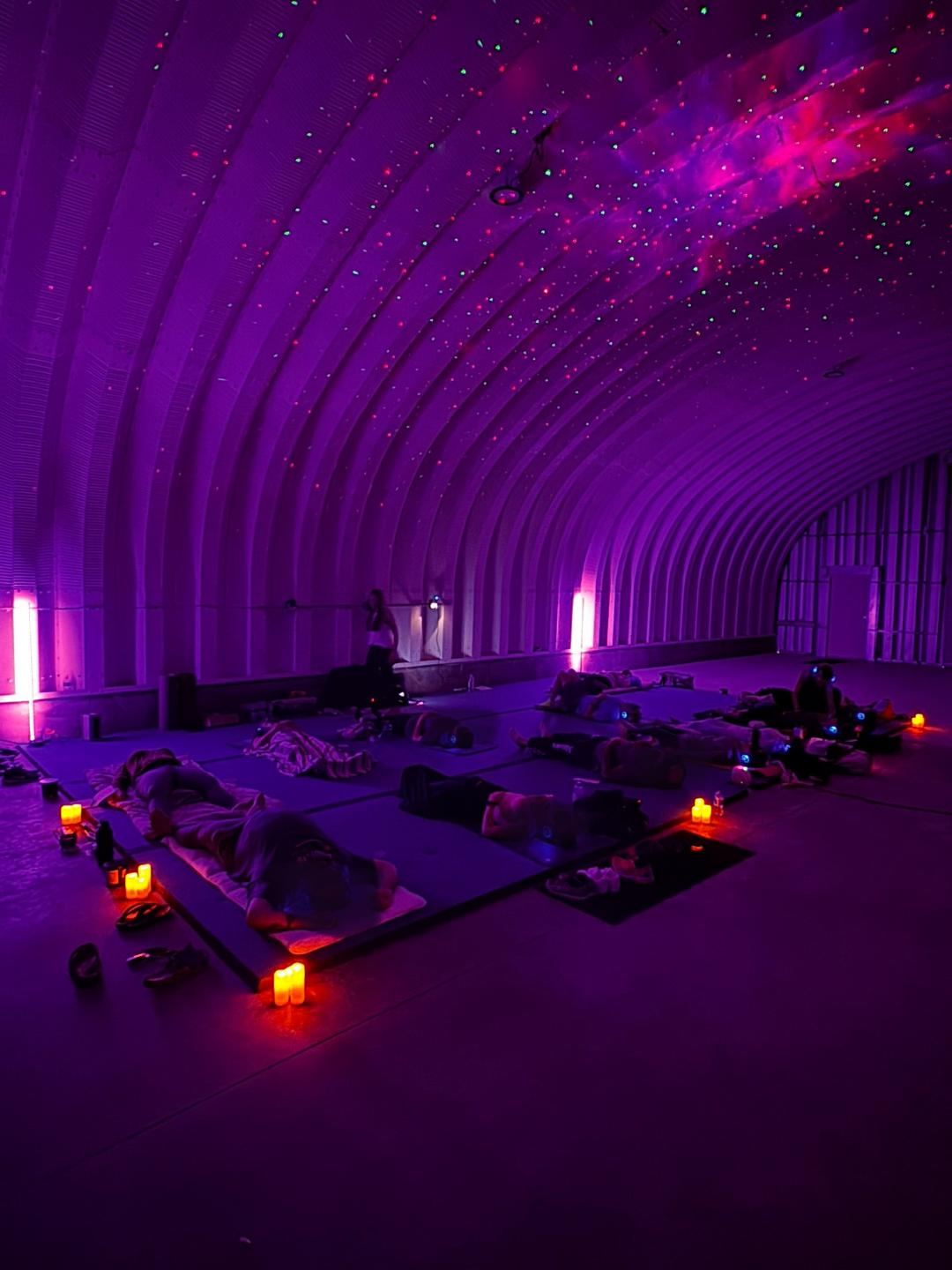
When you lie down for a 9D Breathwork session at Vero Beach Aura, you aren't just breathing; you are engaging in a multi-dimensional symphony of binaural brain entrainment, isochronic tones, and somatic coaching.
During the session, your prefrontal cortex (the analytical, "thinking" part of the brain) steps aside, allowing direct access to the limbic system and the subconscious mind. This is where your deepest "scripts" are stored: the primary trauma imprints, the ancestral lines of lack, and the protective walls you built long ago.
The "high" occurs during this opening. But the healing occurs afterward, when the nervous system begins to recalibrate.
1. Vagal Tone and Nervous System Capacity
True integration increases your vagal tone: the health and functional strength of your Vagus nerve. High vagal tone is associated with the ability to "bounce back" from stress more quickly [4]. If you are integration-focused, you’ll notice that while life still happens, you are no longer a victim of your triggers. You have expanded your capacity to hold the spectrum of human emotion without shattering.
2. Neuroplasticity and Habitual Patterns
Scientific reviews of breathwork highlight its role as a "bottom-up" intervention [2]. By changing the body's state through the breath, we send a signal of safety to the brain. Integration means utilizing this window of safety to choose new behaviors. If you had a breakthrough about "enoughness" in your session, integration is the act of setting a boundary in your workplace the following Monday. Without the action, the neural pathway remains a theory.
Signs You Are Chasing the High (The Drama)
The "Crash" is Severe: You feel enlightened on Sunday and completely dysfunctional or "back to zero" by Tuesday.
Need for Constant Escalation: You feel you need "more intense" sessions or more frequent experiences to feel okay.
The Loop: You keep processing the "same" trauma for years without any change in your external relationships or habits.
Dissociation as "Zen": You feel floaty, detached, or "above it all," but you struggle to maintain focus, pay bills, or connect deeply with loved ones.
Signs You Are Integrating the Work (The Healing)
Subtle Shifts in Reaction: Someone triggers you, and instead of the usual explosion, you feel a pause. You see the trigger, you breathe into it, and you choose a different response.
Improved Biological Markers: Better sleep, more consistent digestion, and a baseline of calm that doesn't require a specific "event" to maintain.
Increased Self-Ownership: You stop looking for a guru or a "fix" and start seeing the breath as a tool you command.
Integration of "Shadow": Instead of pushing away parts of yourself, you begin to welcome them. You aren't "clearing" your anger; you are learning to listen to its wisdom.
How to Ground Your 9D Journey
At Vero Beach Aura, we believe that the transformation is "all facilitated with the simple action of pressing play," but the sovereignty is claimed in the hours that follow. Here is how you can ground your breakthrough:
The 24-Hour Rule
Immediately after a session, your system is in a state of high neuroplasticity. Avoid rushing back into high-stress environments or digital noise. Allow the "bioacoustic sound effects" and "hypnotic therapy" to settle. Drink water, walk barefoot on the earth, and allow your nervous system to register the new state of safety.
Somatic Journaling
Don't just write what you saw; write what you felt. Where did the energy move? Where is it still stuck? By naming the somatic experience, you help the prefrontal cortex integrate the subconscious journey into a coherent narrative.
Use the 9D Library Strategically
Rather than just doing "The Journey to Authenticity" repeatedly, use the specific tools designed for different phases of integration. If you are feeling overwhelmed by the material that came up, use the "Down Regulation & Regeneration" or "Anchor to Presence" sessions. These are designed to stabilize the nervous system, not just open it.
Explore the full 9D Breathwork Library here to find the specific session for your current state of integration.
Are You Ready for the Deep Work?
Transformation is not a spectator sport. It is a courageous, rhythmic, and deeply personal path toward liberation. It is the willingness to look at the "Origin" of your patterns and the "Ancestral Lines" that bind you, and to stay present while they dissolve.
If you are tired of the cycle of "high and crash," and you are ready to build a nervous system that can sustain your highest potential, we invite you to join us. Whether you are a beginner or an advanced explorer, our 9D sessions are crafted to help you not just see the light, but become it.
Ready to step into your power? Book your 9D Breathwork Experience at Vero Beach Aura
References:
Fincham, G. W., et al. (2023). "Effect of breathwork on stress and mental health: A meta-analysis." Scientific Reports.
Price, C. J., & Hooven, C. (2018). "Interoceptive Awareness Skills for Emotion Regulation: Theory and Approach of Mindful Awareness in Body-Oriented Therapy (MABT)." Frontiers in Psychology.
Laborde, S., et al. (2022). "Influence of slow-paced breathing on heart rate variability." Journal of Clinical Medicine.
Balban, M. Y., et al. (2023). "Brief structured respiration practices enhance mood and reduce physiological arousal." Cell Reports Medicine.
Zaccaro, A., et al. (2018). "How Breath-Control Can Change Your Life: A Systematic Review on Psycho-Physiological Correlates of Slow Breathing." Frontiers in Human Neuroscience.
Comments